Japan Business Manager Visa Guide: 30 Million Yen Requirement, Proof of Funds, and How to Avoid Rejection
If you are planning to start a business in Japan, the biggest question is usually this: do you really need 30 million yen for a Business Manager Visa?
This article is for overseas entrepreneurs who want a realistic answer before spending money on office rent, company registration, or relocation. The most common mistake is assuming that having money in the bank is enough. It is not.
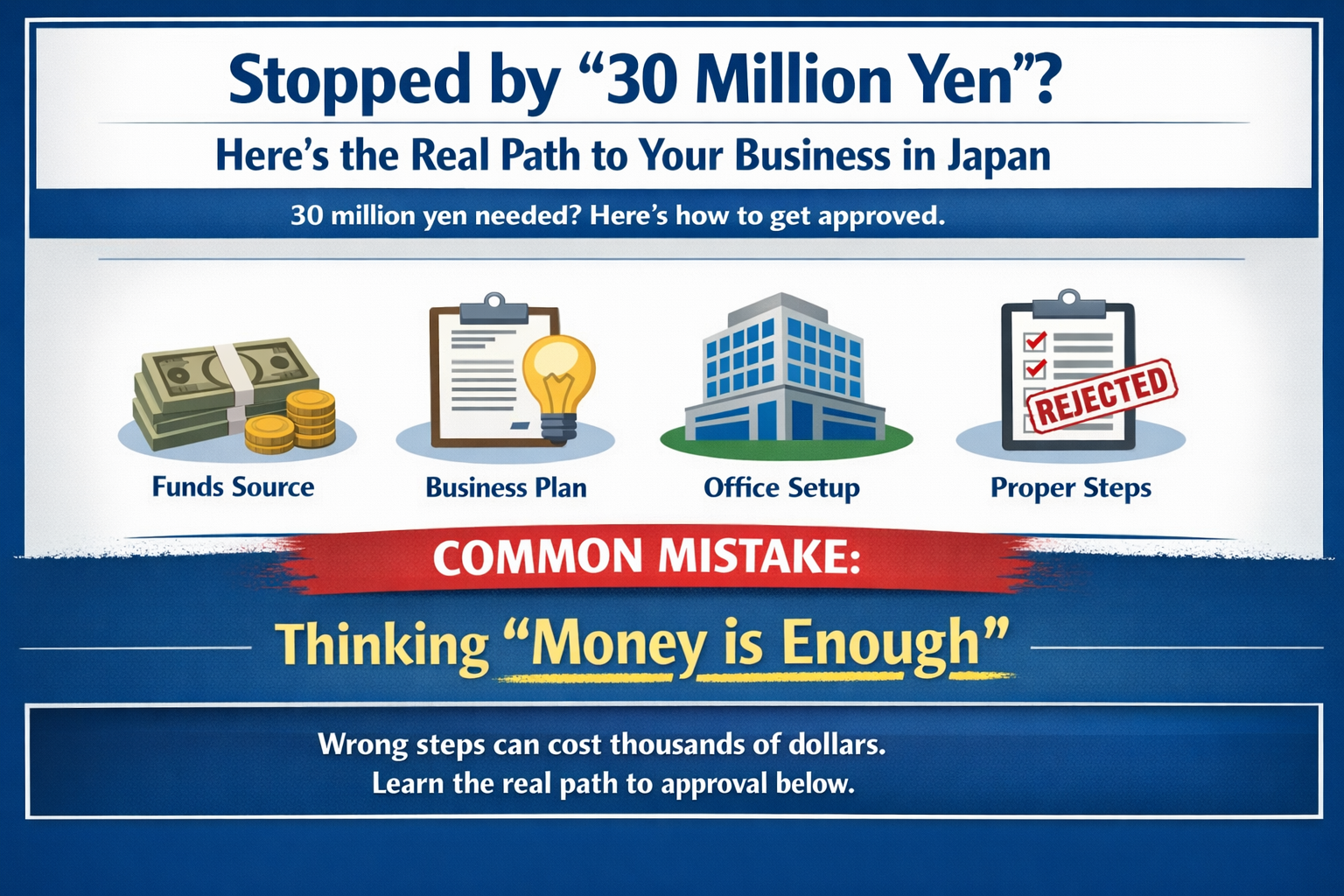
In practice, immigration will look at four things together: your funds, how those funds were built, whether the business plan is credible, and whether the office setup shows a real business presence in Japan.
If you move in the wrong order, the result is not just delay. It can lead to rejection and a large financial loss. This guide explains the real structure in plain English.
Quick Answer
- The current practical standard is 30 million yen in capital or total investment plus at least one full-time employee.
- Immigration does not only check your balance. They look closely at the source and formation process of the funds.
- Your office must show real business substance. A weak office setup can damage the application.
- The correct approach is visa-first planning, not random spending first and explanation later.
- If you proceed in the wrong order, the rejection risk becomes much higher.
This is general practice and may vary depending on the facts of each case.
1. The 30 Million Yen Rule: What It Really Means
Many people still think in the old framework of “500万円 is enough.” That is outdated for practical planning. Under the revised standard, the business scale requirement has become much stricter. In practice, applicants should now plan on the basis of 30 million yen and one full-time employee.
But even this is not the full story.
Immigration is not only asking, “Do you have 30 million yen?” The real question is, “Does this look like a genuine, sustainable business that can be operated in Japan?”
What immigration actually looks at
- Whether the 30 million yen is real and traceable
- Whether the funds belong to the applicant or can be legally explained
- Whether the business plan matches the scale of the investment
- Whether the office, staffing, and operations are realistic
- Whether the overall story is consistent from beginning to end
Example 1: strong case
An applicant worked for 7 years as an executive in Singapore, saved the equivalent of 18 million yen, then sold shares in a small company and received another 15 million yen. Salary records, tax filings, share transfer documents, and bank statements all match. This is the kind of structure that can be explained.
Example 2: weak case
An applicant suddenly receives 30 million yen from a friend two weeks before filing. There is no proper loan agreement, no clear commercial reason, and no explanation of repayment. This is exactly the kind of case that triggers doubt.
Example 3: not enough by itself
An applicant has 35 million yen in the bank, but the business plan is vague, the market analysis is poor, and the office is only a virtual address. Even though the amount is enough, the case is still weak.
Common mistake: Thinking that money alone is enough to pass.
2. Proof of Funds Is Often the Hardest Part
In many Business Manager Visa cases, the biggest problem is not the amount. It is the formation process of the funds.
Immigration wants to know how the money was accumulated. Was it earned through salary, business profits, dividends, asset sales, or family support? Can you prove that with documents? If the answer is unclear, the application becomes dangerous very quickly.
Documents commonly needed
- Bank statements covering a meaningful period
- Salary slips or employment income records
- Tax certificates or tax returns
- Business profit records if the applicant was self-employed
- Sale agreements if funds came from selling assets or shares
- Gift deed or family explanation if family funds are involved
- Wire transfer records showing the movement of money
Why “cash savings” is a problem
Some applicants say, “I kept the money in cash for years.” In practice, this is very hard to use. If there is no reliable paper trail, immigration may not accept the explanation.
Why borrowed money is risky
Borrowed money is not automatically impossible, but it must be explained carefully. If the structure looks temporary, artificial, or unsupported by business reality, it can seriously damage credibility.
Concrete examples
- Salary accumulation: 5 years of income at 8 million yen per year, supported by tax records and bank deposits.
- Business sale: sale of a design company for 42 million yen, supported by the sale agreement and payment records.
- Family support: father transfers 20 million yen, supported by a notarized gift explanation, family relationship documents, and clear bank trails.
The point is simple. The money must make sense on paper.
Common mistake: Submitting a balance certificate without explaining how the money was built.
3. The Business Plan Must Match the Money
A strong Business Manager Visa application is not just about satisfying formal requirements. The business plan must also look commercially believable.
If you claim you need 30 million yen, immigration will naturally ask what that money is for. If your answer is vague, the plan looks inflated. If your numbers are unrealistic, the plan looks artificial.
What a stronger business plan usually shows
- Specific business activities in Japan
- Why Japan is the right market
- How the business will make revenue
- Why the office is necessary
- Why staff are needed
- Why the proposed capital amount is commercially reasonable
Example: stronger explanation
A food export company plans to use 12 million yen for inventory and logistics setup, 6 million yen for initial operating costs, 4 million yen for office and warehouse costs, 5 million yen for employee-related expenses, and 3 million yen for marketing and compliance. This is much more persuasive than simply saying “the business needs funds.”
Example: weaker explanation
An applicant writes only that they want to “do consulting in Japan” and need 30 million yen for “business expansion.” There is no explanation of clients, pricing, operations, or cost structure. This is weak.
Business planning is also where many applicants fail to connect the business to their own background. If your experience does not match the business, you must explain why you are still capable of operating it.
Common mistake: Using a generic business plan that could apply to any country and any applicant.
4. Office Setup Can Make or Break the Application
Office issues are often underestimated. They should not be.
Immigration does not want to see a paper company with no real operational base. The office is one of the clearest signs that the business is real.
Common office pitfalls
- Virtual office only
- Coworking space without exclusive dedicated area
- Home office with no clear separation from private living space
- Lease terms that do not allow business use
- No lease evidence, floor plan, photos, or explanation of actual use
What usually looks better
- Commercial lease or otherwise explainable business-use lease
- Dedicated space for the company
- Clear explanation of how the premises will be used
- Documents such as lease agreement, photos, layout, and signage plan if available
Example 1
An applicant rents a small office in Osaka for 140,000 yen per month, with a lease that clearly permits business use. The submission includes the lease, photos, floor plan, and explanation of how the office supports the business. This is much stronger.
Example 2
An applicant uses a virtual office address in Tokyo and says they will meet clients online. This is much weaker because it suggests no real business substance.
Example 3
An applicant wants to work from home, but the apartment lease prohibits commercial use and there is no separated office area. This is risky.
Common mistake: Treating the office as just an address requirement.
5. The Correct Sequence: Visa-First, Not Spending-First
This is where many people lose money.
Some applicants sign leases too early. Others register a company too early. Others move money into Japan first and only later try to build a legal explanation. That is backward.
The safer approach is visa-first planning. In other words, build the application logic first, then spend in a way that supports that logic.
The correct sequence in principle
- Assess whether the case is viable under the current rules
- Define the business model and applicant role
- Organize proof of funds and supporting records
- Prepare a credible business plan
- Review office structure and lease risk
- Prepare the visa application package
- Proceed with the next commercial steps in the correct order
Why this matters
If you sign the wrong lease, spend heavily on setup, or register a company in a structure that does not fit the immigration logic, you may end up with rejection after already committing large costs.
A realistic cost warning
It is not difficult for an applicant to spend several million yen on deposits, office arrangements, translation, travel, and setup before realizing that the case structure is weak. That is exactly why sequence matters.
Common mistake: Spending first and asking legal questions later.
6. Practical Checklist Before You Proceed
If too many of the points below are missing, the case is not ready.
- Do you have a realistic basis for the 30 million yen amount?
- Can you explain the source and formation process of the funds?
- Do your bank records and tax records support your explanation?
- Does your business plan clearly explain revenue, costs, and operations?
- Does your professional background match the business?
- Do you understand the current staffing expectation?
- Do you have a defensible office plan?
- Does the lease actually permit business use?
- Are your documents consistent across all parts of the application?
- Are you following the correct visa-first sequence?
7. Who Should Not Proceed Yet
Not everyone is ready to apply. It is better to say that early than after large costs have already been incurred.
- Applicants who only have around 5 million yen and are still relying on outdated information
- Applicants who cannot explain where the money came from
- Applicants with no realistic business plan for Japan
- Applicants relying only on a virtual office or weak home-office arrangement
- Applicants trying to patch the case together after spending money in the wrong order
If you proceed without fixing these problems, rejection risk is high.
Our Business Boundary
We support visa strategy, application structure, and document review in the immigration context. We do not provide accounting, bookkeeping, or tax work. We also do not arrange contractors or interior works, and we do not accompany clients for bank account opening.
Mini FAQ
Q1. Can I still apply with only 5 million yen?
Under the current practical standard, that is generally not enough. Planning based on older information is dangerous.
Q2. Is borrowed money allowed?
It depends on the structure and evidence. If the borrowing looks temporary or artificial, it creates major risk.
Q3. Can I use a virtual office?
That is usually weak for this type of application. Immigration generally wants to see a real business base.
Q4. How long does preparation usually take?
That depends on the case, but organizing proof of funds, office arrangements, and the business plan can easily take several weeks to a few months.
Q5. What is the biggest mistake people make?
The biggest mistake is moving in the wrong order: paying first, structuring later, and only then asking whether the immigration logic works.
Next Step
1) 1-minute eligibility check
2) Paid Eligibility Review
Intent self-check: This article is designed for applicants searching for the current 30 million yen requirement and needing a practical decision framework before spending money.